What Small Businesses Can Learn From Serena Williams About Marketing, AI and Showing Up Again

Serena Williams returning to Queen’s and winning her first doubles match after nearly four years away from professional tennis is the kind of moment people pay attention to.
- Not because she needed to prove anything.
- Not because one match defines her career.
But because it showed something every small business owner can learn from.
- Starting again matters.
- Showing up after a break matters.
- Trying something new when people are watching matters.
- Being willing to look a bit rusty at the beginning is part of getting back into the rhythm.
That applies to tennis, but it also applies to marketing, content and learning how to use AI in your business. Because for a lot of small business owners, the hardest part is not the marketing itself, It is getting started again.

Serena Williams did not wait until everything looked perfect
One of the most useful lessons from Serena’s comeback is that she did not wait until everything looked perfect before stepping back onto court. After four years away, there was always going to be attention. There was always going to be commentary. There was always going to be a risk that she would not look exactly like the Serena people remembered. But she still showed up.
This is something I see often with small businesses.
- You want to restart your marketing, but you feel behind.
- You want to post on LinkedIn, but you are not sure what to say.
- You want to use AI, but you feel like everyone else already understands it.
- You want to send an email, update your website, write a blog or start making short videos, but the gap since the last time you did it makes it feel bigger than it is.
So, nothing happens. In most cases, waiting for confidence does not work. Confidence usually comes after you start.
Your first few attempts do not need to be your best work
If you have taken a break from marketing (which I have just done with social media), your first post back might feel awkward.
Your first AI prompt might be clunky.
Your first video might take longer than expected.
Your first blog after months away might feel harder to write than you hoped.
That is normal! The aim is not to create your best work on day one. The aim is to get moving again. What tends to work well is treating the first few attempts as practice rather than proof.
For example:
Write three LinkedIn posts before deciding your voice is not right.
Test five AI prompts before deciding the tool does not work for you.
Publish a simple blog before trying to write the perfect one.
Film a few short videos before judging how natural you feel.
Send one helpful email before creating a full email plan.
Marketing becomes easier when you stop making every action carry the weight of the whole business.
One post does not need to change everything.
One blog does not need to bring in ten leads.
One AI prompt does not need to save you five hours straight away.
You are building a habit, not asking for a miracle.
Comebacks are built on consistency, not noise
Serena Williams has never been known for doing things quietly. But even iconic moments are built on quiet work people do not see.
Training.
Repetition.
Recovery.
Focus.
Decisions.
Discipline.
Small business marketing works in a similar way. The visible part is the post, blog, email, offer or video.
The part that makes it work is usually much less exciting comes from:
Knowing who you are speaking to.
Understanding what they are struggling with.
Repeating your message clearly.
Checking what people respond to.
Showing up even when one post does not perform well.
Improving over time instead of changing direction every week.
Consistency does not mean posting every day until you burn out. It means choosing a level you can keep going with.
For one business, that might be:
One blog per month.
Two LinkedIn posts per week.
One email per fortnight.
One short video per week.
One website update per month.
That is enough to build momentum when the content is clear, useful and relevant.

AI is not something to fear
A lot of small business owners are still unsure about AI.
Some feel like they are too late.
Some worry they will use it wrong.
Some have tried it once, got a bland answer, then decided it was not for them.
But AI is a tool. It is not there to replace your experience, your thinking or your customer knowledge. It can help you get started quicker.
Used well, AI can help with:
Turning rough ideas into first drafts.
Planning blog topics.
Creating content outlines.
Improving headlines.
Repurposing one idea across platforms.
Summarising notes.
Creating FAQs.
Checking whether a message is clear.
Building simple processes.
Saving time on repetitive admin.
The important part is that you stay involved.
AI can give you a starting point. You still need to add context, judgement, examples and your own personality. That is where small businesses have an advantage.
You know your customers.
You know what they ask.
You know where they hesitate.
You know what makes people trust you.
AI helps when you use that knowledge properly.
You do not need to master every AI tool
Another thing that holds people back is thinking they need to learn everything at once.
It quickly becomes too much, but remember, you don’t need to use every tool. Start with one clear problem.
For example:
“I need help planning my weekly content.”
“I need to turn meeting notes into actions.”
“I need to write better email subject lines.”
“I need to create blog outlines faster.”
“I need to repurpose long content into short posts.”
“I need to make my website copy clearer.”
Then choose one tool to help with that one task. That is a much better starting point than signing up to five platforms then using none of them properly.
AI works best when it fits into how your business already works.
Marketing needs repetition
Serena did not become Serena by hitting one good serve. She became Serena through repetition, pressure, learning, adapting and showing up again. Small business marketing needs the same mindset. People often want to say something once, then move on because they feel like they are repeating themselves. But your audience is busy.
They do not see everything you post.
They may need to hear the same message in different ways before it lands.
They may read your blog one week, see your LinkedIn post the next, then remember you months later when they need help.
This is why repetition matters.
You can repeat:
Who you help.
What problems you solve.
How your service works.
What people get from working with you.
What makes your approach practical.
Common mistakes you help people avoid.
Simple tips your audience can use straight away.
Repetition is not boring when the message is useful. It is how people start to understand what you do.
You can be experienced and still be learning
One of the best things about watching someone return after a long break is the reminder that experience does not remove the need to adapt. You can be brilliant at what you do and still need to find your rhythm again. That is true in business too.
You might have years of experience, strong client relationships and a solid service, but still feel unsure about AI, short-form video, LinkedIn, email marketing or SEO. That does not mean you are behind. It means the way businesses communicate keeps changing.
The aim is not to chase every trend.
The aim is to keep learning enough to stay relevant, useful and visible.
For small businesses, that might mean:
Learning how to write better prompts.
Understanding how to use AI safely.
Improving your website copy.
Showing more of your process online.
Creating content that answers real customer questions.
Building simple systems so marketing does not always feel last-minute.
Small improvements add up.
A simple way to restart your marketing
If Serena’s comeback made you think about your own business momentum, start small. This week, choose one thing. Not ten things. One.
You could:
Write one LinkedIn post about a common customer question.
Update one page on your website.
Ask AI to help turn a voice note into content ideas.
Create a list of five blog topics.
Send one email to your list.
Write down ten questions customers ask you.
Review your Google Business Profile.
Plan next week’s content in advance.
The point is to rebuild the habit.
Once you start, you get feedback.
Once you get feedback, you can improve.
Once you improve, marketing starts to feel more manageable.
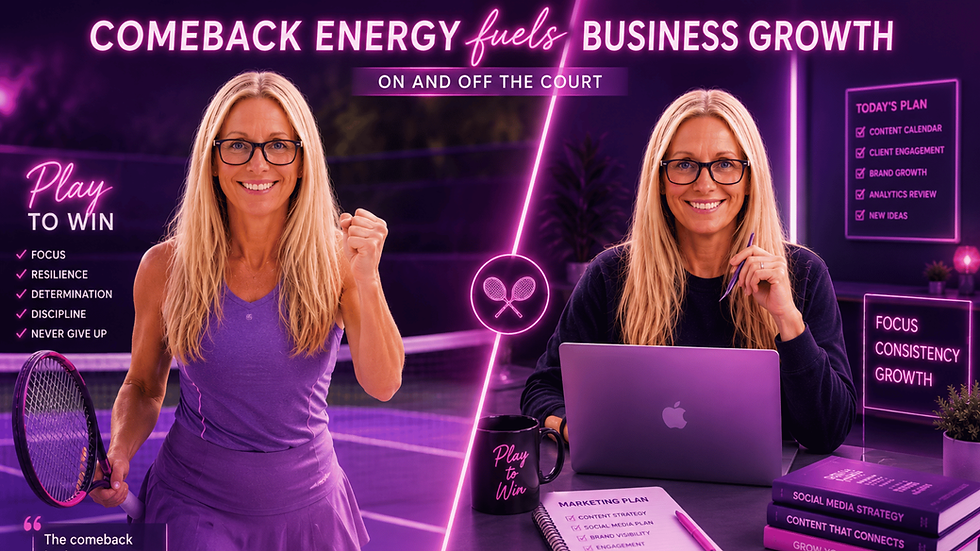
What small businesses can take from Serena’s comeback
There are a few simple lessons here.
You do not need perfect conditions to start again.
You do not need to feel fully confident before you use AI.
You do not need to post every day to be consistent.
You do not need to copy what everyone else is doing.
You do need to keep showing up.
You do need to be willing to learn.
You do need to make your marketing easier to repeat.
You do need to use tools in a way that supports your business, rather than making things feel more complicated.
Serena Williams returning after four years and winning at Queen’s is an iconic sporting moment.
For small business owners, it is also a useful reminder.
You can pause and still come back.
You can feel rusty and still get started.
You can learn something new at any stage.
And your next move does not need to be perfect. It just needs to happen.
FAQs
What can small businesses learn from Serena Williams’ comeback?
Small businesses can learn the value of starting again, staying consistent and being willing to improve in public. Marketing often feels harder after a break, but momentum usually comes from taking small actions rather than waiting until everything feels perfect.
How does this relate to small business marketing?
Marketing needs consistency, repetition and confidence. Serena’s comeback is a useful example of showing up after time away, trusting your experience and rebuilding rhythm. Small businesses can apply the same thinking to content, blogs, email marketing, SEO and social media.
What does Serena Williams’ mindset teach business owners?
Her mindset shows that experience, resilience and action matter. You do not need to prove everything in one moment. In business, the same applies. One post, one blog or one AI tool will not define your success, but consistent action can build real progress over time.
How can small businesses start using AI tools?
Start with one task. For example, use AI to plan blog topics, draft social media ideas, summarise notes, improve headlines or repurpose content. Keep the task simple, review the output and add your own experience before using it.
Should small businesses be afraid of AI?
No. AI is a tool to support your thinking, not replace it. The best results come when you combine AI with your own knowledge of your customers, your services and your business.
How can I restart my marketing after a break?
Pick one manageable action. Write one post, update one website page, plan one blog or use AI to create a content outline. The aim is to rebuild the habit. Once you are moving again, it becomes easier to stay consistent.
Further Reading:
· LTA: Serena Williams secures comeback victory with Victoria Mboko
Useful source for the tennis hook. It confirms Serena Williams’ return at Queen’s, the doubles win with Victoria Mboko and the match context.
· Microsoft Work Trend Index 2025
Good supporting reference for how AI is becoming part of everyday work, decision-making and business productivity.
· HubSpot AI Trends for Marketers 2025
Useful marketing reference showing how AI is being used by marketers for content, productivity, planning and performance.
· Think with Google: The Future of AI-Powered Search Marketing
Helpful for linking the blog back to SEO, search behaviour and how AI is changing the way people find information online.
· McKinsey: The State of AI in 2025
Strong business-level reference on AI adoption, experimentation and how organisations are starting to use AI more strategically.
· Stanford AI Index Report 2025
A broader data-led report on AI development, adoption, investment and responsible AI. Useful for readers who want wider
If your marketing has slipped, or you know AI could help but you are not sure where to start, I can help you make it feel manageable.
I work with small businesses to simplify their marketing, create clear content plans and use AI tools in a way that supports how they actually work.
Get in touch and let’s make a simple plan that helps you start showing up again.

Need a smarter way to keep your business visible on LinkedIn? I rate ContentSwarm* — and you can save 20% on your subscription with the code GEMMA.
If you’re looking for help or support for a marketing project to help your business grow by improving your online presence, please check out the Digital Marketing Services I Provide.
Not sure or want to have a chat about this in more detail then please Contact Me directly.
Are you looking to upskill and learn more about AI, Business Analysis, Data Protection?
Check out these Online Courses now.


Love